Duolingo vs Babbel vs Rosetta Stone: Best App for the Easiest Languages
The Language Research Desk
As an Amazon Associate we may earn a commission from qualifying purchases made through links on this page, at no extra cost to you.
This page is the three-app head-to-head for the easiest Category I languages. The eight-app ranked list is Best Language Learning Apps: 8 Apps Compared and Ranked; the shorter job-to-be-done stack is what works and what does not.
The Language Research Desk does not run a 90-day lab and does not claim a test fleet. The notes below are listing checks against published course structure, pricing pages, and how English-speaking beginners usually waste a first month: paying for two phrase apps, farming XP, or treating speech recognition as conversation.
Language learning apps have become the default starting point for new language learners, and for good reason: they are accessible, structured, and fit into busy schedules. But with dozens of options available, choosing the right app matters --- especially in the first months when building a daily habit is crucial.
This comparison focuses on the three most popular apps --- Duolingo, Babbel, and Rosetta Stone --- evaluated specifically for learning the easiest languages for English speakers (Spanish, French, Italian, Dutch, Norwegian, Portuguese). Category I hour bands still apply; an app streak is practice time on the FSI clock, not a substitute for it.
Quick Comparison
| Feature | Duolingo | Babbel | Rosetta Stone |
|---|---|---|---|
| Price | Free tier available; Super: ~$7/month | ~$7-13/month | ~$12-15/month |
| Teaching method | Gamified exercises, inductive learning | Structured lessons, explicit grammar | Immersive, no English translations |
| Session length | 5-15 minutes | 10-20 minutes | 20-30 minutes |
| Languages offered | 40+ | 14 | 25 |
| Grammar explanation | Minimal | Thorough | None (learn by context) |
| Speech recognition | Basic | Good | Very good |
| Live tutoring | No | No | Yes (with subscription) |
| Offline mode | Super only | Yes | Yes |
| Best for | Daily habit, casual learners | Serious beginners, grammar focus | Immersive learners, pronunciation |
Duolingo: The Daily Habit Builder
How It Works
Duolingo teaches through short, gamified exercises: matching words to pictures, translating sentences, fill-in-the-blank, and listening comprehension. Lessons take 5-15 minutes. The app uses streaks, XP points, leaderboards, and achievement badges to motivate daily practice.
The free tier includes all lesson content with ads between exercises. Duolingo Super ($6.99/month) removes ads, adds offline mode, and provides unlimited lives.
Strengths
Habit formation: Duolingo’s gamification is genuinely effective at getting people to practice daily. The streak system creates accountability, and the short lessons lower the barrier to starting.
Breadth of languages: Duolingo offers courses in over 40 languages, including less common options like Norwegian, Dutch, and even Welsh. Their Norwegian and Dutch courses are considered among the platform’s best.
Community-built courses: Some of Duolingo’s best courses (Norwegian, Dutch) were built with significant input from native-speaking volunteers, resulting in natural, practical content.
Zero cost entry: The free tier provides access to all lesson content. You can learn effectively without paying.
Weaknesses
Grammar explanations are thin. Duolingo teaches inductively --- you figure out grammar rules by seeing patterns in examples. This works for some learners but frustrates those who want to understand why things work a certain way.
Limited speaking practice. Duolingo’s speaking exercises are typically “repeat this sentence,” not free conversation. This builds pronunciation but not conversational ability.
Gamification can become the goal. Some users optimize for XP and streaks rather than actual learning. Doing easy review exercises for streak maintenance is common but not productive.
Translation-heavy. Many exercises involve translating between English and the target language, which reinforces English-mediated thinking rather than direct target-language processing.
Best For
Casual learners, absolute beginners, people who struggle with consistency, and learners of less-common languages (Norwegian, Dutch) where Duolingo’s courses are strong.
Babbel: The Structured Teacher
How It Works
Babbel organizes content into themed lessons that build progressively. Each lesson introduces vocabulary and grammar in context, with explicit rule explanations in English. Lessons take 10-20 minutes and include listening, speaking, reading, and writing exercises.
Babbel requires a paid subscription: approximately $13.95/month, $9.95/month for 6 months, or $6.95/month for 12 months. They occasionally offer lifetime access deals.
Strengths
Explicit grammar instruction. Babbel tells you the rules. When you learn that Spanish uses “ser” for permanent states and “estar” for temporary ones, Babbel explains this distinction clearly. For adult learners who want to understand structure, this is valuable.
Practical conversation focus. Lessons are built around real-world scenarios: ordering food, making small talk, handling airports, discussing your job. The vocabulary and phrases you learn are immediately usable.
Review system. Babbel’s review feature uses spaced repetition to reinforce vocabulary at optimal intervals. This is more sophisticated than Duolingo’s review mechanism.
Speech recognition. Babbel’s speech recognition technology provides feedback on pronunciation, which is helpful for self-learners without access to native speakers.
Course quality consistency. Because Babbel’s courses are created by in-house linguists rather than volunteers, quality is consistent across languages.
Weaknesses
No free tier. You must pay to access content. This makes it harder to evaluate before committing.
Fewer languages. Babbel offers only 14 languages. No Norwegian, Dutch, or less-common options.
Less engaging. Babbel’s interface is professional but less addictive than Duolingo’s gamification. Learners who need external motivation may struggle with consistency.
Limited advanced content. Babbel’s courses typically cover beginner through intermediate levels. Advanced learners need to transition to other resources.
Best For
Serious beginners who want structured, grammar-rich learning. Adults who learn best through explicit explanations. Learners of Spanish, French, Italian, Portuguese, and German.
Rosetta Stone: The Immersive Approach
How It Works
Rosetta Stone teaches entirely in the target language --- no English translations, no grammar explanations. You learn by associating words with images and building understanding through context and repetition. Lessons are longer (20-30 minutes) and progress methodically.
The current subscription costs approximately $11.99/month, $7.99/month for 12 months, or a lifetime access option around $179. The subscription includes live tutoring sessions with native speakers.
Strengths
True immersion approach. By avoiding English entirely, Rosetta Stone trains your brain to think in the target language from day one. Some learners find this produces more natural, intuitive language use.
Excellent speech recognition. Rosetta Stone’s TruAccent technology is widely regarded as the best speech recognition among language apps. It provides detailed pronunciation feedback.
Live tutoring included. The subscription includes group tutoring sessions with native speakers. This addresses the biggest weakness of app-only learning: actual conversation practice.
Structured progression. The course moves from simple to complex in a logical, well-paced progression.
Weaknesses
No grammar explanations. If you want to know why the verb goes here or the adjective changes form, Rosetta Stone will not tell you. You are expected to absorb rules through exposure. This works for patient learners but frustrates analytical thinkers.
Slow pace. The immersive, no-translation method requires more time to convey concepts that a grammar explanation could handle in seconds.
Price. Rosetta Stone is the most expensive option, especially for the monthly subscription.
Artificial scenarios. Some exercises feel disconnected from real communication needs. Learning to say “The horse is red” before learning to order coffee frustrates practically-minded learners.
Best For
Learners who prefer learning without English crutches. Those who want built-in pronunciation coaching. People willing to invest more time per session. Learners who also want live tutoring included in their subscription.
Which App for Which Language?
| Language | Best App | Why |
|---|---|---|
| Spanish | Babbel or Duolingo | Both are excellent; Babbel for structure, Duolingo for habit |
| French | Babbel | Grammar explanations help handle pronunciation rules |
| Italian | Babbel or Rosetta Stone | Babbel for grammar, Rosetta Stone for pronunciation immersion |
| Norwegian | Duolingo | One of Duolingo’s best courses; Babbel does not offer Norwegian |
| Dutch | Duolingo | Strong course; Babbel does not offer Dutch |
| Portuguese | Babbel | Good structured course for Brazilian Portuguese |
How to use the app you pick (not just open it)
A session that only taps green tiles is a habit. A session that produces a sentence is study. Use the same 15–20 minute block this way:
- New lesson first (8–12 minutes). Do the unit you have not finished. Skip easy recap if the app is steering you toward XP.
- Say the new lines aloud (2–3 minutes). Pause after each prompt. Speech recognition is a repeat-after-me check, not a conversation.
- Write three original sentences (3–5 minutes) using today’s words. If you cannot, the lesson was recognition-only — look the rule up in a textbook from best books to learn Spanish or best books to learn French.
- One speaking appointment per week once you can form basic sentences. That is a tutor or an exchange app, not a second phrase app.
Duolingo-specific: Turn off the instinct to farm easy reviews for a streak. If the path offers a hard practice, take it. Super is an ads-and-lives SKU.
Babbel-specific: Read the grammar note before the drill. If you skip the explanation, you paid for a worse Duolingo. Use Review on days you cannot start a new lesson.
Rosetta Stone-specific: Do not guess in English in your head and then tap the picture. Name the image in the target language first. Use the included group tutoring if you already pay; do not add italki in the same week until you know you will keep both.
A four-week cadence for Category I languages
This is a workload check, not a fluency diary. Spanish, French, Italian, Portuguese, Dutch, and Norwegian still sit near 600–750 classroom hours on the how long it takes page.
| Week | Daily (15–20 min) | Weekly add-on | Skip |
|---|---|---|---|
| 1 | One app only. Finish the first unit. Speak every new sentence aloud. | None. Confirm the language is actually in the app (Babbel has no Norwegian or Dutch). | Super, lifetime, a second app. |
| 2 | Same app. Add 5–10 minutes of learner audio (Coffee Break or Language Transfer). Show notes live on best podcasts to learn languages. | Write a five-line diary twice. | Buying headphones to “unlock” the app. |
| 3 | Same app plus one grammar lookup when a pattern repeats. | One 20–30 minute exchange or trial tutor if you can greet and answer “what do you do?” | Stacking Babbel on top of Duolingo. |
| 4 | Keep the streak app or switch once if the method is a mismatch (you need rules → Babbel; you need Norwegian → Duolingo). | Keep one speaking slot. Cut the app you abandoned. | Paying for all three. |
If progress goes quiet while you are still opening the app, that is a plateau diagnosis, not a reason to buy Rosetta Stone on top of Babbel.
Buying criteria and skip-buy notes
Pay for a plan only when a locked feature is the job you actually use:
| Listing | Pay when | Skip when |
|---|---|---|
| Duolingo Super | Ads break every lesson and you already finish a unit most days | You are still in week 1 or you only open the app for the streak |
| Babbel monthly vs 12-month | You finished the first paid unit and want the grammar notes | You have not compared it to Duolingo’s free course for that language |
| Babbel “lifetime” | The sale lists your language and a refund window you can live with | The SKU is a license dump with languages you will not study |
| Rosetta Stone monthly | You want TruAccent and you will use the included group sessions | You already have a tutor and a grammar book; the no-English method is a preference, not a requirement |
| Rosetta Stone lifetime (~$179 class of deal) | You will stay on one language for a year and will use the live sessions | You want a cheap experiment; monthly or a different app is the test |
Do not buy two of these as your whole method. One drill app plus a speaking path is a stack. Headphones on this page are commute audio, not a fluency product.
Common pitfalls on this three-app choice
- Optimizing for XP or a leaderboard. That is Duolingo’s business model working. Switch the goal to “three new sentences I can say without looking.”
- Treating speech recognition as speaking practice. All three apps score a prompt you just heard. A human who interrupts you is a different product.
- Switching apps every week. Give one app three weeks unless the language is missing (Babbel) or the no-English method is making you quit (Rosetta Stone).
- Lifetime as a commitment device. A prepaid license does not create a habit. Unused lifetime seats are common.
The Best Approach: Use an App Plus Other Resources
No app alone produces fluency. The most effective approach combines an app with complementary resources:
- Daily app practice (15-20 minutes) for vocabulary and grammar
- A good textbook for grammar reference --- see our best Spanish books guide for one language
- Podcast or audio course for listening practice (Coffee Break series, Pimsleur)
- Conversation partner for speaking practice (italki, Tandem, HelloTalk)
- Native media for immersion (Netflix, music, YouTube)
For a complete rundown of tools beyond apps, see our best language learning tools and resources guide.
Supplement Your App: Recommended Physical Products
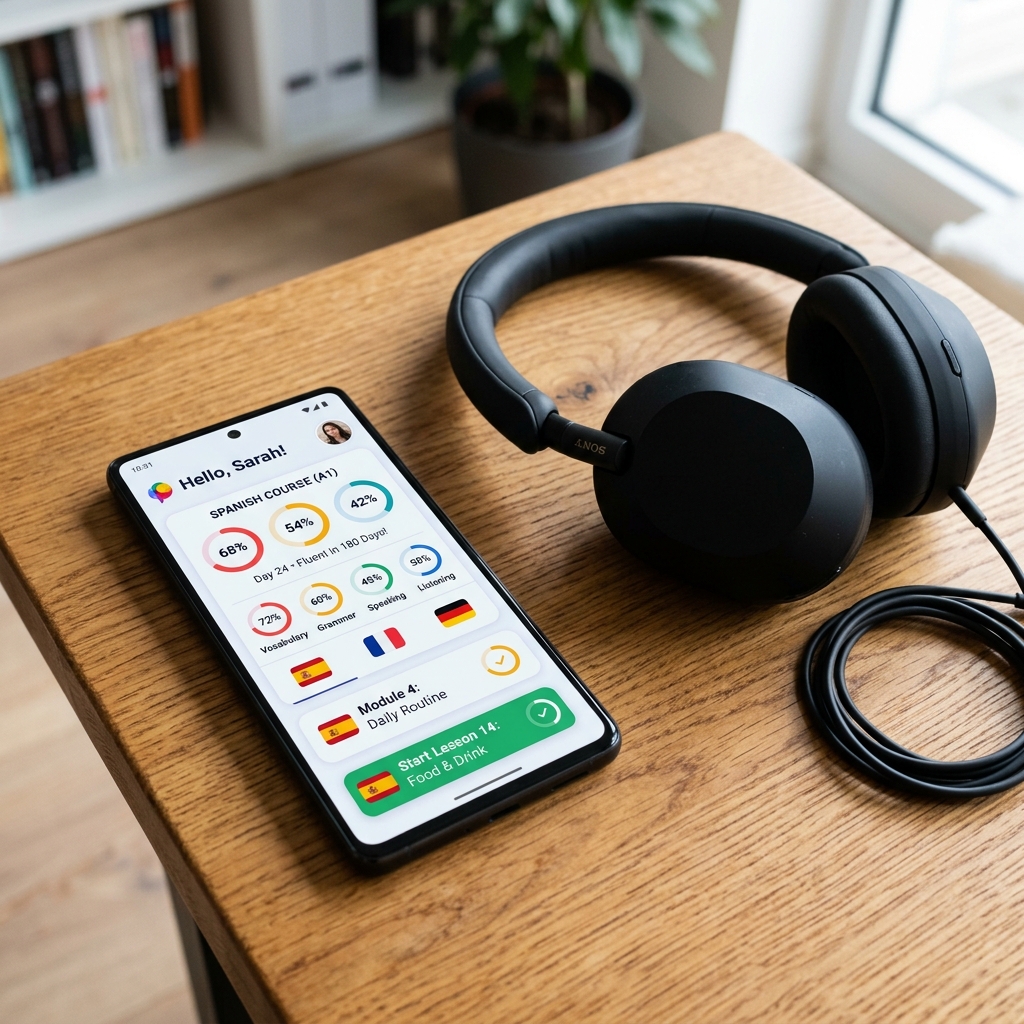
A good pair of headphones makes a real difference for audio lessons and pronunciation practice:
-
Sony WH-1000XM5 Wireless Headphones --- Excellent noise cancellation for focused study sessions. Industry-leading sound quality for catching subtle pronunciation differences. Check price on Amazon →
-
Apple AirPods Pro 2 --- Great for listening to language podcasts on the go. Active noise cancellation and transparency mode. Check price on Amazon →
Listing check (The Language Research Desk): Confirm WH-1000XM5 vs a newer Sony line, and AirPods Pro 2 vs a later Pro, plus seller and return window. These are commute-audio suggestions for app lessons, not a product-schema review.
For the eight-app ranked table, see 8 apps compared and ranked. For a shorter “what each tool is for” stack, see what works and what does not.
The Bottom Line
Choose Duolingo if you want a free, habit-forming daily practice tool, especially for Norwegian or Dutch.
Choose Babbel if you are a serious beginner who wants structured grammar explanations, especially for Spanish, French, Italian, or Portuguese.
Choose Rosetta Stone if you prefer immersive learning without English translations and want live tutoring included.
Most learners will benefit most from starting with Babbel or Duolingo and adding other resources within the first month. The app is the foundation, not the whole house.
If you still need a priced eight-app table (Busuu, Pimsleur, Anki, Language Transfer), use 8 apps compared and ranked. If you only need “what job is empty,” use what works and what does not. A wider kit — books, flashcards, study audio — is best language learning tools.
Frequently Asked Questions
Which language learning app is the best overall? ▼
There is no single best app. Babbel is best for structured grammar learning and serious beginners. Duolingo is best for casual daily practice and building a habit. Rosetta Stone is best for immersive learners who prefer learning without English translations. Most successful language learners use an app as one component alongside other resources.
Is Duolingo actually effective for learning a language? ▼
Duolingo is effective for building basic vocabulary and grammar through gamified daily practice. A 2023 study commissioned by Duolingo found that 4 semesters of Duolingo produced reading and listening scores comparable to 4 semesters of university study. However, Duolingo alone rarely produces conversational fluency. It works best as part of a broader learning strategy.
Is Babbel worth the subscription cost? ▼
At roughly $7-13/month depending on plan length, Babbel is a good value for learners who want structured, grammar-focused lessons. It explains rules explicitly (unlike Duolingo's inductive approach) and teaches practical conversation scenarios. For serious learners willing to invest in a paid app, Babbel is widely recommended.
Is Rosetta Stone still relevant in 2026? ▼
Rosetta Stone has evolved significantly from its original CD-ROM format. The current subscription version includes speech recognition, live tutoring sessions, and a mobile app. Its immersive method (learning without English translations) works well for some learners but frustrates others. It is a legitimate option but no longer the default recommendation it once was.
Can I learn a language using only free apps? ▼
Yes, but it requires more effort to assemble a complete learning approach. Duolingo's free tier, Language Transfer (free audio courses), YouTube channels, and free conversation partners through Tandem can form an effective free stack. Paid resources save time by providing structure but are not strictly necessary.
How long should I use an app before switching to other methods? ▼
Most learners benefit from adding conversation practice, reading, and listening within the first 1-2 months, even while continuing to use an app. Think of the app as your daily vocabulary and grammar workout, and other methods as the activities that develop real communication ability.
Do I need Duolingo Super, a Babbel lifetime deal, or Rosetta Stone lifetime? ▼
No, not in the first month. Super removes ads and lives; it does not add a tutor. Babbel annual is usually enough to test whether you will open the app. Lifetime licenses are a term, not a method — read which languages and which features are included. Skip all three upgrades if you are not finishing free or monthly lessons.
Should I use Duolingo, Babbel, and Rosetta Stone at the same time? ▼
No. They overlap on beginner phrases. Pick one daily drill app. Add speech (a tutor or exchange partner) and a textbook or podcast when those jobs are empty. Stacking all three subscriptions is a common first-month waste.
We research and compile information about language learning from linguistic studies, FSI data, and language learning communities.
Related reading
 Book Reviews
Best Books to Learn Spanish for Beginners
The best Spanish textbooks, workbooks, and readers for beginners in 2026. Reviewed by learning style with honest pros and cons.
 Book Reviews
Best Books to Learn French by Self Study
The best French textbooks, workbooks, and readers for self-study. Reviewed with honest pros, cons, and which learning style each fits.
 App Reviews
The 7 Best Language Exchange Apps for Real Conversation Practice in 2026
Desk notes on HelloTalk, Tandem, italki community, and other exchange apps — matching jobs, free-tier limits, and when not to pay Pro.