Best Language Learning Tools and Resources for Beginners
The Language Research Desk
As an Amazon Associate we may earn a commission from qualifying purchases made through links on this page, at no extra cost to you.
There is no single tool that will make you fluent. Language learning requires a combination of resources, each serving a different purpose: vocabulary building, grammar instruction, listening practice, speaking practice, and immersion. This guide is a desk kit list — apps, books, flashcards, and study audio — not a merchant catalog and not a claim that The Language Research Desk ran a hardware lab.
Store pages sell “complete fluency systems.” The desk reads each listing as a job: one structured course, one listening path, one speaking path. The ranked app scorecard is 8 apps compared and ranked. The shorter “what each app is for” stack is what works and what does not. This page sits between those two and the book/tutor siblings.
The Essential Tool Stack
Before diving into specific products, here is the framework for what you need:
| Tool Category | Purpose | Time Investment | Priority |
|---|---|---|---|
| Structured course (app or textbook) | Grammar and vocabulary foundation | 15-20 min/day | Essential |
| Flashcard app | Vocabulary retention | 5-10 min/day | High |
| Audio resource (podcast/course) | Listening comprehension | 15-20 min/day | High |
| Speaking practice (tutor/partner) | Conversational ability | 30-60 min/week | High |
| Native media (shows, music, books) | Immersion and cultural context | As much as you enjoy | Moderate |
| Reference (dictionary, verb tables) | Quick lookup | As needed | Moderate |
Best Language Learning Apps
The three-app head-to-head is Duolingo vs Babbel vs Rosetta Stone. Below is the kit-level summary plus the extra tools this page has to name. These are job labels, not App Store star copy.
Duolingo (Free / $6.99/month for Super)
Job: Daily habit, Norwegian, Dutch, and other courses bigger paid apps skip. Super removes ads; it does not add a tutor.
Babbel (~$7-14/month)
Job: Structured grammar for Spanish, French, Italian, Portuguese. Confirm the language is in the 14-language list before you treat a sale price as the plan.
Rosetta Stone (~$8-15/month)
Job: Immersion-without-English and TruAccent prompts. Lifetime vs monthly are different licenses — read which languages are included.
Pimsleur (~$15-21/month or individual courses)
Job: Audio-first production for commuters. The app subscription is not the same SKU as a Level 1 CD box. Pair with a text course; do not buy it as a complete method.
Language Transfer (Free)
Job: Grammar-through-dialogue audio. Spanish, French, Italian, German, Greek, Turkish, and Swahili. Donation-supported; there is no “Pro” unlock hiding the real course.
HelloTalk / Tandem (Free with premium options)
Job: Reciprocal text and voice with strangers, not a curriculum. For the platform comparison see best language exchange apps. Paid correction is a different product on best online language tutors.
Best Textbooks by Language
For Spanish textbook recommendations, see the detailed best books to learn Spanish guide. French self-study titles live on best books to learn French. Here are top picks for other languages, with edition checks rather than jacket blurbs:
French
- Assimil French With Ease --- The polyglot community’s favorite French course. Progressive bilingual text with audio. Check price on Amazon →
- Practice Makes Perfect: Complete French All-in-One --- Comprehensive grammar reference with exercises. Check price on Amazon →
Italian
- Assimil Italian With Ease --- Same excellent method applied to Italian. Check price on Amazon →
- Italian Short Stories for Beginners (Olly Richards) --- Engaging graded readers. Check price on Amazon →
Dutch
- Complete Dutch: Teach Yourself --- One of the few comprehensive Dutch courses for English speakers. Check price on Amazon →
Norwegian
- The Mystery of Nils --- Teaches Norwegian through a detective story. Popular and well-reviewed. Check price on Amazon →
General (any language)
- Fluent Forever (Gabriel Wyner) --- Not a language course but a method book teaching you how to learn any language effectively. Covers pronunciation, vocabulary acquisition, grammar learning, and immersion strategies. Check price on Amazon →
Best Flashcard Tools
Anki (Free on desktop/Android, $24.99 on iOS)
The flexible spaced-repetition engine. Anki lets you create custom cards and schedules reviews from recall quality. The learning curve is steep. Community-shared decks exist for most languages; quality varies, so treat a downloaded deck as a listing to spot-check, not as a course. Desktop/Android vs the paid iOS app are different products. Which flashcard app fits which learner is on best flashcard apps for vocabulary; the algorithm itself is on spaced repetition science.
Brainscape (Free tier / Premium ~$10/month)
A more polished alternative to Anki with a simpler interface. Good community-made decks for common languages.
Physical Flashcards
Some learners retain information better with physical cards. Vis-Ed produces popular foreign language flashcard sets:
-
Vis-Ed Spanish Vocabulary Cards (1,000 cards) --- Classic vocabulary flashcard set covering essential Spanish words. Check price on Amazon →
-
Vis-Ed French Vocabulary Cards (1,000 cards) --- Same format for French. Check price on Amazon →
Best Audio Equipment for Language Learning
Good audio quality makes a measurable difference in language learning --- you catch pronunciation nuances, reduce listening fatigue, and stay focused longer.
Noise-Cancelling Headphones (For Focused Study)
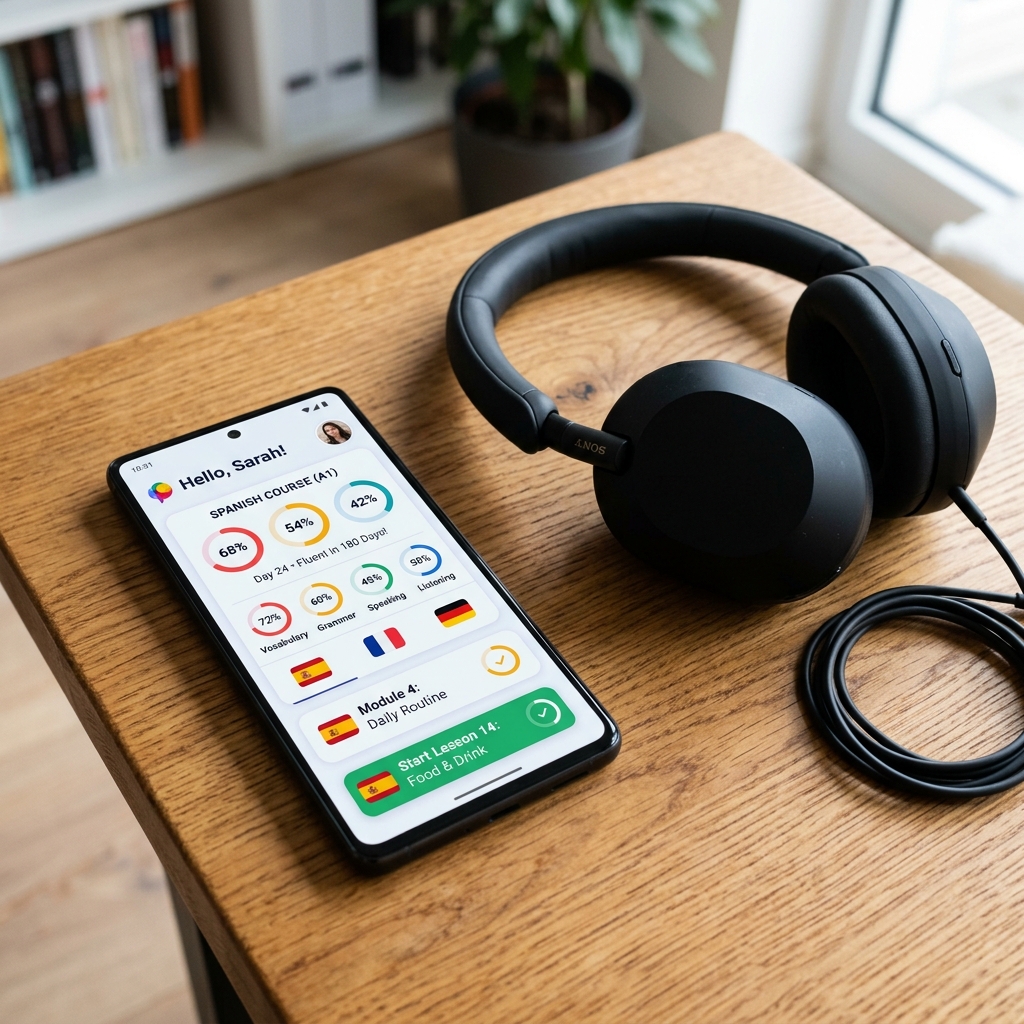
Sony WH-1000XM5 --- Over-ear ANC that is commonly used for Pimsleur-length sessions and tutor calls. The desk is not scoring “industry-leading”; it is a model number you must match on the Amazon page.
Apple AirPods Max --- Over-ear Apple ANC. A different product from AirPods Pro. Confirm Max vs Pro vs a later generation before you buy from a marketplace seller.
Earbuds (For Podcasts and Commuting)
Apple AirPods Pro 2 --- Active noise cancellation in earbud form. Excellent for language podcasts during commutes, workouts, and daily errands.
Samsung Galaxy Buds3 Pro --- Strong ANC, good sound quality, and comfortable fit. Best for Android users.
Budget Option
Anker Soundcore Life Q30 --- Surprisingly good noise cancellation and sound quality at a fraction of premium headphone prices. A solid choice if you want ANC without the premium price tag.
Listing check (The Language Research Desk): Treat headphone and flashcard ASINs as hardware to verify, not as a scored catalog. On Amazon, confirm the exact model (WH-1000XM5 vs a later XM; AirPods Pro 2 vs Max; Vis-Ed language and card count), new vs marketplace seller, and that you are not buying a different generation with the same marketing name. Book links above should match language and series (Assimil With Ease, Teach Yourself Complete Dutch, Mystery of Nils).
Best Podcasts for Language Learners
Podcasts are free, portable, and a listening job — not a speaking job. The full show list is best podcasts to learn languages. Video siblings are on best YouTube channels to learn languages. A short starter grid:
| Language | Beginner Podcast | Intermediate Podcast |
|---|---|---|
| Spanish | Coffee Break Spanish | Notes in Spanish |
| French | Coffee Break French | InnerFrench |
| Italian | Coffee Break Italian | News in Slow Italian |
| Portuguese | PortuguesePod101 | Brazilianpodclass |
| Norwegian | NorwegianClass101 | NRK Radio |
| Dutch | DutchPod101 | NOS Journaal (news) |
Best Video Resources
YouTube Channels (Free)
- Easy Languages series (Easy Spanish, Easy French, Easy Italian, etc.) --- Street interviews with native speakers, with subtitles in both languages. Excellent for listening practice.
- SpanishPod101 / FrenchPod101 / etc. --- Structured video lessons on YouTube.
- Dreaming Spanish --- Comprehensible input method for Spanish at all levels.
Streaming Platforms
Netflix, HBO Max, and Amazon Prime all offer content in multiple languages with subtitle options. Set both audio and subtitles to your target language for maximum benefit.
Best Writing Tools
Journal
A simple notebook for writing practice. Write a few sentences daily about your day in your target language. This is one of the most underrated language learning activities.
- Leuchtturm1917 Notebook --- Lay-flat binding and numbered pages make it practical for daily writing practice. Check price on Amazon →
Online Tutoring
- italki --- Find affordable private tutors ($5-25/hour depending on language and tutor). Book lessons as needed.
- Preply --- Similar platform with tutor matching based on your goals.
- Conversation exchange (free) --- Tandem and HelloTalk apps match you with native speakers for free language exchange.
Building Your Personal Tool Stack
Budget: Free
- Duolingo (free tier) + Language Transfer + Tandem + YouTube channels + public library books
Budget: $15-20/month
- Babbel subscription + Anki (free) + one podcast + Tandem + library books
Budget: $50-75/month
- Babbel subscription + one textbook from this guide + weekly italki tutor session + podcast + headphones (one-time purchase)
Budget: $100+/month
- Premium app + textbook + bi-weekly italki tutoring + Pimsleur + quality headphones + streaming subscriptions
Desk buying notes (kit, not a cart)
These are listing checks, not a scored offer:
- Do not buy five tools on day one. One structured course, one audio path, and one speaking path is a kit. Extra headphones and extra textbooks do not fill an empty speaking job.
- Match the SKU. Assimil With Ease vs a different Assimil language; Pimsleur Level 1 vs a “complete” bundle; Vis-Ed Spanish vs French; WH-1000XM5 vs a later XM. The Amazon title is not always the edition discussed above.
- Headphones are study audio. The desk does not put them in Product schema and does not rank them as language courses. Confirm model number, seller, and return window.
- Tutors are not a line item you add after an app “fails.” If speech is the empty job, skip another subscription and use best online language tutors or language exchange apps.
How to use the kit (not how to fill a cart)
The table at the top is a job list. A week that works looks like this — not like five unboxed products.
Most weekdays (40–55 minutes total):
- One structured course (15–20 minutes). Duolingo or Babbel or one textbook chapter. Speak new lines aloud. If you cannot form a sentence after the lesson, the tool was a quiz — open the grammar book, do not download a second app.
- One listening path (15–20 minutes). Language Transfer, Pimsleur, or a show from best podcasts to learn languages. Hands-free is fine. Do not stack Pimsleur and a Pod101 subscription for the same commute.
- Reviews (5–10 minutes). In-app queue first. Add Anki or Vis-Ed only when those queues miss words from reading or tutoring.
Once a week: 20–40 minutes of speech. Exchange first; tutor when you need interruption. Writing three diary lines in the Leuchtturm (or any notebook) on the same day beats a blank premium journal.
First week only: Confirm the language exists on the paid app, the Assimil title matches the language you want, and the headphone ASIN is the model you intended. Then stop shopping.
Who this kit is for
- Absolute beginner, zero budget: Duolingo + Language Transfer + Tandem + library book. Headphones optional.
- Beginner who wants rules: One textbook from the language lists above + Babbel or the book’s exercises, not both as primary.
- Commuter: Pimsleur or Coffee Break, plus a short evening drill. The Pimsleur vs app note applies: CD, download, and subscription are different SKUs.
- Already speaking a little: Keep one course, add a reader (Olly Richards / graded), add a weekly tutor. Cut duplicate apps.
Pitfalls
- Buying WH-1000XM5 to “hear the language better” while still skipping the speaking slot.
- Owning Assimil French and Assimil Italian before finishing lesson 20 of either.
- Treating Vis-Ed cards as a course. They are a word list you must schedule.
- Paying Super, Babbel, and a tutor marketplace in month one. That is three checkouts for two jobs (drill + speech).
If the language itself is still undecided, use what is the easiest language for English speakers before you buy a kit. Methods (input vs SRS vs conversation) are compared on language learning methods.
The Bottom Line
The most important “tool” is consistent daily practice. A free stack of Duolingo + Language Transfer + YouTube will outperform a $200/month setup that you use inconsistently. Start with the essentials (one app, one audio resource, one way to speak), add tools as you identify gaps in your learning, and treat headphones as optional study audio, not a fluency purchase.
For language-specific advice, see our guides on Spanish, French, Italian, Dutch, and Norwegian. For a broader perspective on which language to learn, see our 10 easiest languages ranking.
Frequently Asked Questions
What tools do I actually need to learn a language? ▼
At minimum, you need one structured learning resource (app or textbook), one listening resource (podcast or audio course), and one way to practice speaking (tutor, conversation partner, or language exchange). Beyond that, flashcard apps for vocabulary and native-language media for immersion are highly valuable but not strictly necessary to start.
How much should I spend on language learning tools? ▼
You can learn a language for free using Duolingo, Language Transfer, public library books, and free conversation partners through Tandem. A moderate budget of $10-20/month for an app subscription plus $30-60 for a textbook is enough for most learners. Online tutoring through italki costs $5-15 per session.
Are expensive language courses worth it? ▼
Expensive immersive programs and bootcamps can be effective but are rarely necessary. Research shows that consistent daily practice with affordable tools produces comparable results to expensive courses over similar timeframes. The most important factor is how much you practice, not how much you spend.
Do I need noise-cancelling headphones for language learning? ▼
While not strictly necessary, good headphones improve your language learning experience significantly. Noise cancellation helps you focus during study sessions and catch subtle pronunciation differences in audio lessons. Any comfortable headphones work, but noise-cancelling models are particularly useful for studying in noisy environments.
What is the best free language learning resource? ▼
Language Transfer (free audio courses for Spanish, French, Italian, German, and others) is widely regarded as the best free language learning resource available. It teaches grammar intuitively through a conversation-style format. Combined with Duolingo's free tier for daily practice, you have a strong foundation at zero cost.
What should I buy first from this toolkit? ▼
Nothing on day one if a free app plus Language Transfer plus a library book will start the week. Buy one structured course (app or textbook) when you will finish lessons. Buy a tutor hour when speech is the empty job. Skip headphones, a second textbook, and a flashcard subscription until those are clearly the bottleneck.
How do I use this kit in a normal week? ▼
Most days: 15–20 minutes on one course, 15 minutes of audio, 10 minutes of reviews. Once a week: a speaking slot. Open the dictionary or verb book only when a sentence fails. Do not rotate five tools in one sitting.
We research and compile information about language learning from linguistic studies, FSI data, and language learning communities.
Related reading
 Book Reviews
Best Books to Learn Spanish for Beginners
The best Spanish textbooks, workbooks, and readers for beginners in 2026. Reviewed by learning style with honest pros and cons.
 Book Reviews
Best Books to Learn French by Self Study
The best French textbooks, workbooks, and readers for self-study. Reviewed with honest pros, cons, and which learning style each fits.
 App Reviews
The 7 Best Language Exchange Apps for Real Conversation Practice in 2026
Desk notes on HelloTalk, Tandem, italki community, and other exchange apps — matching jobs, free-tier limits, and when not to pay Pro.